

What is It?
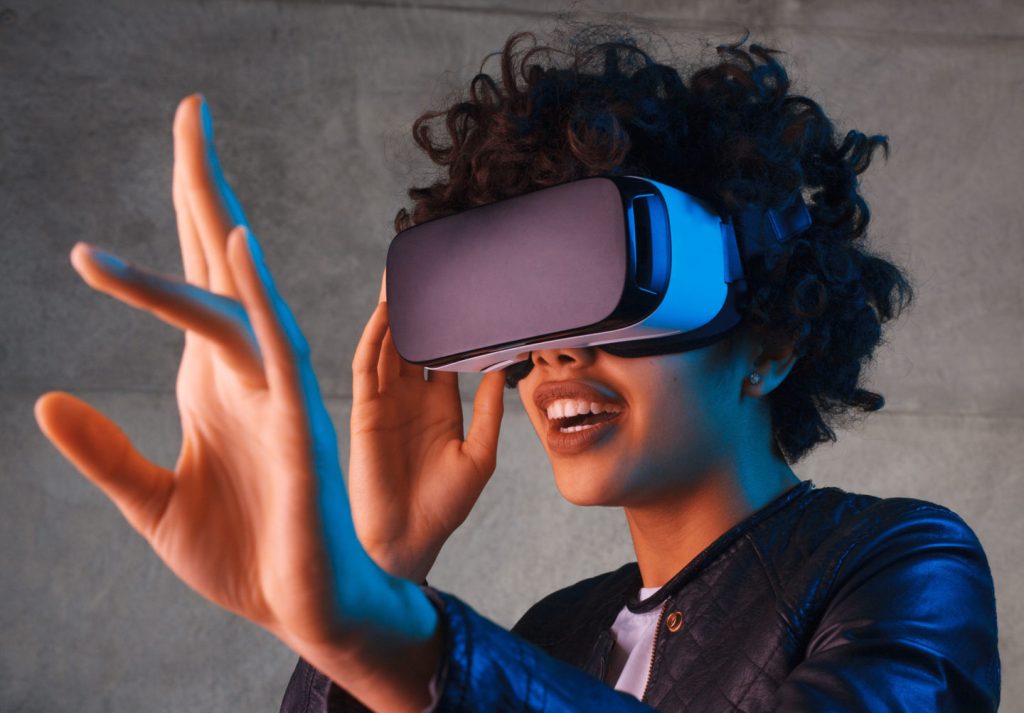
Virtual Reality is the creation of a stimulated environment using computer technology. Instead of the individual having a screen to interact with, users are placed inside the experience, allowing for objects and shapes to be interacted with. Virtual Reality stimulates many senses, such as vision, hearing, touch and smell. Virtual reality has limitations such as reliability, cost and the availability (Bardi, 2019). The difference between Virtual Reality and Augmented Reality is that Augmented Reality stimulates an artificial object into in the real-world environment. (See previous blog for more information on augmented reality).
Virtual Reality in Education
Virtual Reality has the potential to be beneficial when used in the correct manner (Ainge, 1997). When used in an educational setting, Virtual Reality can increase motivation, spatial thinking and change how an individual views learning. Research suggests that when compared to direct teaching, Virtual Reality has better educational outcomes (Blazauskas, et al, 2017). However, Virtual Reality is expensive, time consuming and teachers will need to be trained on using the technology. If Virtual Reality is used incorrectly, motivation may decline, and pedagogical outcomes will not occur (Kizilkaya, L., et al, 2019). Overall, teachers shouldn’t use the technology as a ‘silver bullet’, educational outcomes need to be the bases of the lesson, not the technology (Blazauskas, et al, 2017).
CoSpaces
CoSpaces is an interactive technology platform that enables students to learn through experiences. CoSpaces allows the user to create a Virtual Reality world and Augmented Reality world using a variety of objects and shapes. These objects and shapes can be rotated, enlarged, shrunk to fit into certain environments. Just like other mentioned technologies, CoSpaces incorporates coding and offers the opportunity for student creativity to flourish.
I found CoSpaces to be user friendly and easy to navigate. I would like to see further research into the usefulness of Cospaces in regard to pedagogical outcomes as there was little research available.



References
Ainge, D. (1997). Virtual Reality in Schools: The Need for Teacher Training. Innovations In Education And Training International, 34(2), 114-118. https://doi.org/10.1080/1355800970340206
Blazauskas, T., Maskeliunas, R., Bartkute, R., Kersiene, V., Jurkeviciute, I., & Dubosas, M. (2017). Communciations in Computer and Information Science (pp. 457-465). Springer International Publishing.
Davis., H (2017).Create and explore 3D worlds in the classroom with CoSpaces and ClassVR – Immersive It. Immersive It.Retrieved 11 May 2020, from http://immersiveit.com.au/create-explore-3d-worlds-classroom-cospaces-classvr/.
Kavanagh, S., Luxton-Reilly, A., Wuensche, B., & Plimmer, B. (2017). A systematic review of Virtual Reality in education. Themes in Science & Technology Education, 10(2), 85–119.
Kizilkaya, L., Vince, D., & Holmes, W. (2019). Design prompts for virtual reality in education. Lecture Notes in Computer Science (including Subseries Lecture Notes in Artificial Intelligence and Lecture Notes in Bioinformatics), 11626, 133-137.


2 replies on “Virtual Reality”
Hi Austyn,
I agree wholeheartedly in wishing that there was some academic literature on CoSpaces itself rather than just Virtual Reality (VR). There are so many different applications and variations within the program itself that it would be interesting to know which elements of it are more effective for classroom engagement. For example, I found the space environment you had chosen for your VR was quite effective compared to the 3D reproductions of animals even though they are design-wise very similar. Perhaps this has something to do with the fact that we are more used to what animals look like close up than planets! I can see it being a great way for students to recreate and explore otherwise inaccessible places. The only information I could find were reviews for the product itself sadly–I suppose this is why it is still an emerging technology!
LikeLike
Hi Austyn,
Thank you for sharing your perspectives on visual reality. I agree with your idea that visual reality has both the positive and negative side of education. Also, CoSpace is a good tool for students to create the VR and AR world.
There are some ideas on how the CoSpace can give the opportunity for students to be creative. However, maybe expand more on this with regarding some research will be better. Moreover, it will make your blog more effective when you can add some pedagogical reflections.
Thank you!
LikeLike